
Blog
Every organization runs on documents. Invoices, lab reports, contracts, transcripts, and applications all hold critical information, but not every system can easily read or use that data. A scanned PDF might contain a patient ID or invoice number, yet without structure, it’s just another file sitting in storage.
This is where Intelligent Document Processing (IDP) steps in. It’s more than just scanning or OCR. IDP uses machine learning, natural language processing, and validation logic to pull meaningful data out of your documents. The real value comes when that data automatically connects to your systems—like content management platforms, electronic medical records (EMRs), or analytics tools.
When documents and business systems finally “speak” to each other, work becomes faster, errors drop, and data insights become visible.
How Intelligent Document Processing Works
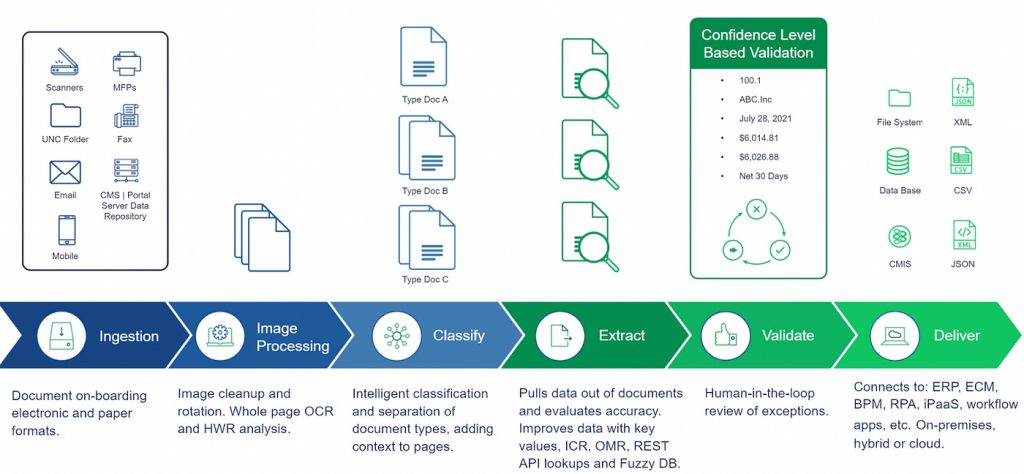
IDP combines several technologies to read, understand, and organize information:
OCR (Optical Character Recognition)
Converts printed text in PDFs or images into digital, searchable text.
ICR (Intelligent Character Recognition)
Extends OCR to handwritten forms, allowing you to digitize notes, signatures, and forms.
Machine Learning and Natural Language Processing (NLP)
Helps the system recognize document types—like invoices or lab orders—and find key fields automatically.
Validation Rules
Ensure extracted data meets your business requirements, such as valid ID numbers, dates, or totals.
A Simple Example
Imagine a university receiving 1,000 student applications in one week.
Applications are scanned or uploaded.
IDP classifies them as admission forms.
The system extracts student IDs, programs of interest, and enrollment terms.
Data is validated against admission requirements.
Structured information flows into the student information system, while the original files are stored in OnBase for compliance.
What used to take weeks now happens in minutes.

Connecting IDP to OnBase
OnBase is one of the most popular enterprise content management platforms. Without IDP, most documents enter OnBase as static images with little context. Staff often search by date or folder names, wasting valuable time.
When IDP integrates with OnBase:
Documents arrive with metadata such as student ID, invoice number, or patient MRN.
Staff can search by meaningful fields instead of filenames.
Workflows trigger automatically—like routing a contract for approval or sending a financial aid form for review.
By enriching documents with structured data, IDP transforms OnBase from a storage system into an active process engine.
Connecting IDP to EMRs
Healthcare organizations handle one of the heaviest document loads—referrals, claims, lab results, and patient notes. Without automation, staff spend hours typing and uploading information manually.
With IDP:
A lab report is scanned.
The system extracts patient identifiers, test results, and physician details.
Data flows directly into the EMR (Epic, Cerner, or Meditech).
The report is indexed and archived in OnBase for compliance.
This dual integration ensures clinicians see critical information quickly while compliance teams maintain a secure archive.
Connecting IDP to Databases and Analytics
Not every business system is a repository or EMR. Many organizations rely on databases, warehouses, or BI dashboards for tracking and decision-making. IDP supports these workflows too.
Finance: Invoices processed through IDP feed accounts payable databases for real-time reporting on vendor spend.
Education: Admissions and enrollment data populate dashboards that track application volume and processing times.
Healthcare: Patient forms feed registries for research and compliance tracking.
With validated, structured data flowing into analytics platforms, organizations can turn document information into meaningful insights.
Integration Methods
There are two main ways IDP connects with other systems:
APIs (Application Programming Interfaces)
APIs create direct, secure links between IDP and systems like OnBase or Epic. They enable real-time data transfer and two-way communication, allowing IDP to verify information against existing records.
RPA (Robotic Process Automation)
When APIs aren’t available, RPA bots mimic human actions—typing data into legacy systems. It’s a flexible way to integrate IDP into older environments without expensive development.
This combination of options makes IDP adaptable to both modern and legacy systems.
Why Downstream Integration Matters
An IDP solution is only powerful if the data it captures goes somewhere useful. Without integration, you might extract great information but never apply it.
When IDP connects downstream, organizations see clear results:
Speed: Tasks that once took weeks now take hours.
Accuracy: Validation removes human error.
Compliance: Every step is logged for audit trails.
Insights: Data that was once buried in PDFs becomes usable for analysis.
Real-World Examples
Healthcare
A hospital processing 20,000 lab reports monthly uses IDP to extract results and load them into the EMR. Clinicians access reports instantly, while compliance teams have searchable archives in OnBase.
Insurance
An insurance carrier receives thousands of claims weekly. With IDP, each claim is automatically read, validated against policy records, and uploaded to the claims management system. The process reduces manual entry and speeds up approvals.
Corporate Finance
A business office uses IDP to capture vendor IDs, invoice amounts, and due dates from incoming invoices. The system feeds this data into a SQL database, triggering payment workflows and providing real-time cash flow visibility.
Higher Education
Universities process admissions, financial aid, and registrar forms through IDP. Extracted student information flows to the Student Information System, while the files stay indexed in OnBase. Staff focus on students, not paperwork.
Closing Thoughts
Intelligent Document Processing isn’t just a smarter way to scan. It’s a way to connect your upstream document capture with your downstream business systems.
By integrating IDP with platforms like OnBase, EMRs, and analytics databases, organizations reduce manual work, strengthen compliance, and gain insights that improve decision-making.
For healthcare systems, universities, insurance carriers, and enterprises, IDP is more than a tool—it’s a foundation for digital transformation.
If your organization wants to modernize document workflows and connect systems seamlessly, Onsite Management Group can help you get started with Intelligent Document Processing today.
FAQs About Intelligent Document Processing
What is Intelligent Document Processing?
It’s a system that uses AI, machine learning, and OCR to extract and organize data from documents automatically.
What systems can IDP integrate with?
It works with platforms like OnBase, Epic, Cerner, Meditech, SQL databases, and most business applications through APIs or RPA.
Is Intelligent Document Processing secure?
Yes. IDP uses encryption, access control, and audit logs to protect sensitive data and maintain compliance.
How does IDP improve efficiency?
It reduces manual data entry, increases accuracy, and delivers data directly into the systems that need it.
What industries use IDP most?
Healthcare, finance, education, insurance, and logistics all benefit from Intelligent Document Processing.